An AI-enabled SDLC is built, not bought.
IBOTSystems is a PlayerZero implementation partner. What we've learned re-engineering SDLCs around PlayerZero, Claude, and the tools in between — and where the ROI of AI investment actually lives.
Engineering organizations bought the AI tools. The seats are assigned, the licenses renewed, the demos were impressive. And in most of the organizations we walk into, the ratio that matters — capacity spent sustaining the system versus compounding it — hasn’t moved.
That’s not a tool problem. IBOTSystems is a PlayerZero implementation partner, and every implementation has taught us the same thing: the tool is a line item. The practice is the investment. This post is about what that practice looks like when it’s built properly — and why the organizations that treat AI adoption as a purchasing decision keep getting demos instead of returns.
A seat is not a system
Individual AI coding tools compound the individual. An engineer with a good assistant writes code faster, understands unfamiliar files faster, drafts tests faster. That’s real, and we install it everywhere we go.
But an SDLC is not a collection of individuals. It’s a system: tickets flow into plans, plans into changes, changes into reviews, reviews into releases, releases into support load. When AI lives only in the editor, every one of those handoffs still runs on scattered context — the ticket in one tool, the telemetry in another, the history in a senior engineer’s head. The assistant made one stage faster. The system still queues on the same people it always queued on.
A tool without a system is noise. The organizations that get returns from AI are the ones that re-engineer the system itself — stage by stage, with owners, gates, and memory. That is precisely the work we do, and it’s why we chose a platform partner for it.
Why we partnered with PlayerZero
PlayerZero builds a living model of how software actually works in production — a knowledge graph connecting the codebase, tickets, telemetry, and user sessions, everything anchored to the code. On top of that model, its agents do the work that usually lands on your best engineers: triage, root-cause investigation, PR review against acceptance criteria, regression detection, release documentation.
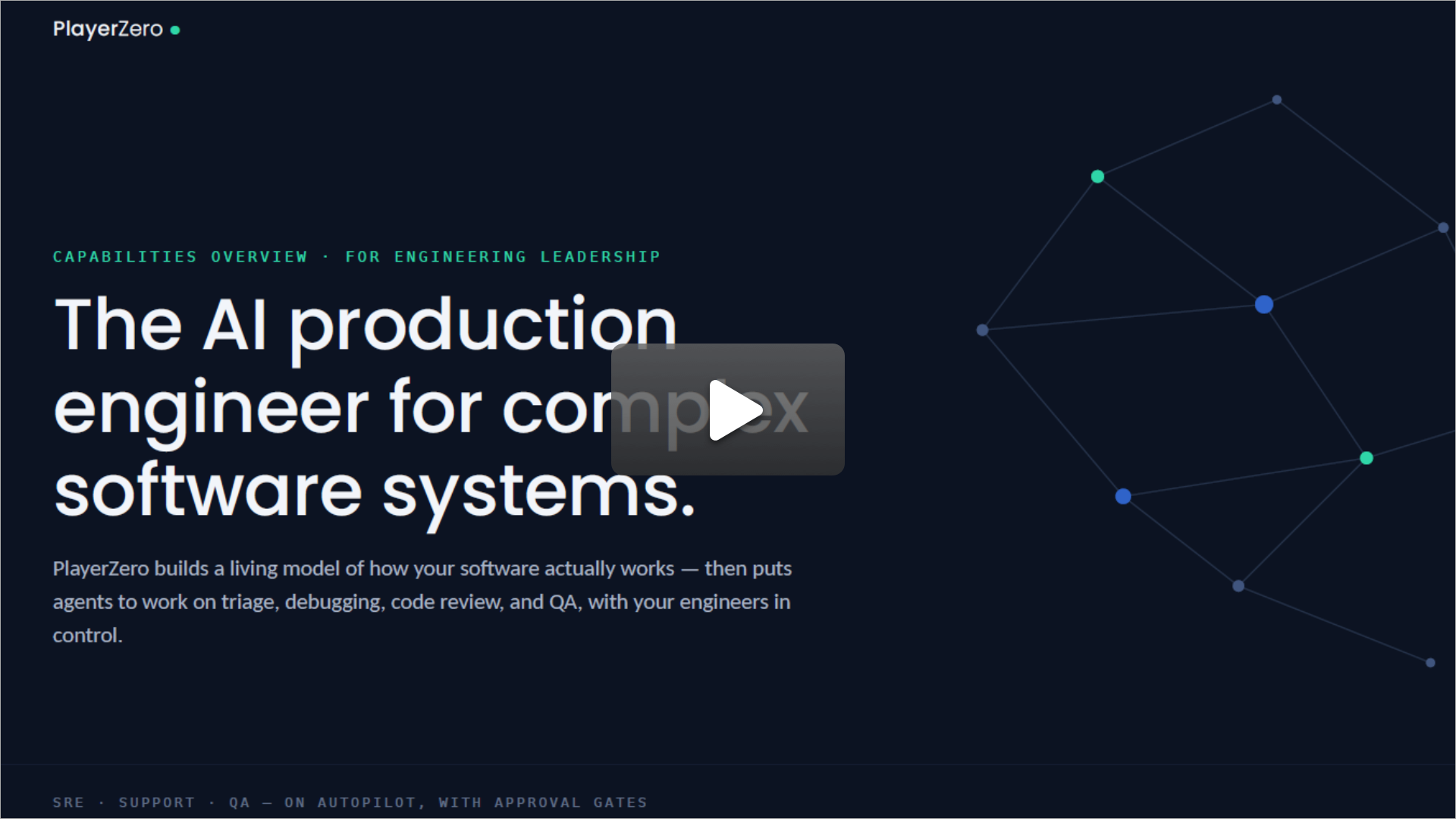
Prefer it on paper? Download the PlayerZero Capabilities Overview (PDF) — a 14-page walkthrough of the platform, from the world model to the pilot path.
Two design decisions made it the platform we standardize on.
First, it’s built for the system, not the seat. PlayerZero’s unit of work is the workflow: multi-stage pipelines with an approval policy at every transition. Autonomy is a dial, not a switch — routine classification can advance automatically while anything touching a fix requires sign-off, and the policy can change as trust accrues.
Second, it compounds. Every resolved incident and validated change feeds the model. The platform gets better at your system the longer it runs — institutional memory that doesn’t walk out the door when people do.
A platform with those properties still has to be installed into a real SDLC, with real teams, real legacy repos, and real compliance constraints. That’s the partnership: PlayerZero is the system layer; we’re the practice that builds your SDLC onto it.
What a PlayerZero-enabled SDLC looks like
Across our implementations, the shape that works has five stages — each one grounded in the same world model, each one gated the way the organization needs.
Plan. A ticket goes in; an implementation plan comes out — where the change should live, what existing code to reuse, ordered steps with effort, risk, edge cases, and the tests that prove it. Scoping stops being a meeting and starts being a reviewable artifact.
Build. Changes are analyzed in the context of the whole system: dependencies, ownership, and the history of what broke before. Engineers keep their authoring tools — this is where assistants like Claude do their best work — but the change is understood at the system level, not just the diff level.
Review. Every acceptance criterion on the ticket is mapped to the code that satisfies it. Out-of-scope changes, missing tests, and unimplemented criteria get flagged with cited evidence. Review verifies intent, not just syntax.
Ship. Releases are watched against the model of what the system did before — catching behavioral drift that unit tests were never written to see. Release notes, executive summaries, and acceptance guides are generated from the tickets and code that actually shipped, with the source of truth cross-checked against what’s actually on the production branches.
Support. Incoming tickets are classified — user error, technical bug, feature request — investigated against code, logs, and sessions, and routed through a pipeline with human gates exactly where the organization wants them: security, billing, data loss, compliance, anything ambiguous. The agent is configured to raise a hand instead of guessing.
None of this is theoretical. These are the playbooks we install, adapted to each organization’s repos, ticketing system, and risk posture.
The ROI is in the routing
Here is the part most AI adoption plans skip, and the reason so many of them fail the CFO’s second-year question.
An AI-enabled SDLC runs on more than one tool, and the tools have very different unit economics. The cost discipline is architectural: route each stage of the SDLC to the cheapest capability that does the job well, and reserve premium reasoning for the stages where it pays.
In practice that means assistants like Claude where engineers author and reason about code — the highest-leverage, most human-gated work in the pipeline. It means PlayerZero where production context lives — triage, review, regression, release — because those stages are worthless without the world model behind them. And it means tiering models within the pipeline: economy models for routine classification, premium reasoning for root-cause work, auto-optimization where the platform supports it. Cost control designed into the pipeline, not bolted on as a quarterly license review.
Measured that way, the ROI stops being hand-wavy. Triage time, escalation rate, defect escapes, release overhead — every one of these is a number the organization already tracks, and every one of them moves when the system is built right. PlayerZero’s customers publicly report triage going from days to minutes and escalations dropping by double-digit percentages. What we add is the discipline that makes those numbers reachable in your SDLC, at a spend profile that survives the renewal conversation.
What the implementations taught us
Five things we now hold as practice, learned the hard way so our clients don’t have to.
Start where the pain is measurable. Support triage and PR review, not greenfield code generation. The first win should show up in a metric the leadership team already watches, within weeks.
Gate before you automate. Every stage starts human-approved. Loosen the gates as the audit trail earns trust — never the other way around. Teams that start at full autonomy retreat to no autonomy after the first bad experience.
Anchor everything to one source of truth. Plans are scoped from the ticket, reviews verify against the ticket, closures certify the ticket. The moment agents work from side channels, the compounding stops.
Review against acceptance criteria, not diffs. A diff review catches syntax. Mapping every criterion to the code that satisfies it catches the defect that spans services, contributors, and releases — the one manual review misses.
Make every fix teach the system. If a resolved incident doesn’t update the model, you’ve paid for the resolution twice: once now, and again when the next on-call rediscovers it.
The take
Tools get you demos. Practice gets you compounding.
The organizations that win with AI in engineering aren’t the ones with the most seats. They’re the ones that re-engineered the SDLC itself — one world model under it, agents doing the queue work, humans owning the gates, and cost discipline routed into the pipeline. That’s what we build as a PlayerZero implementation partner, and it’s the same expertise whether the stage runs on PlayerZero, Claude, or the next tool worth adding to the stack.
Stop buying AI. Start building the SDLC that makes it pay.
If your AI tools are live but your sustaining-versus-compounding ratio hasn’t moved, get in touch — or read about our PlayerZero implementation practice. We ship code, not slides.